DiscoverSim Optimization Methods
- Home /
- DiscoverSim Optimization Methods
Output: The output will be a function of the model equation, intermediate cell calculations, as well as input distributions and input controls.
Input Control: The permissible range for the control is specified, and the control, which unlike an input distribution, has no statistical variation. Think of this as a control knob like temperature. This is also known as a "Decision Variable". An input control can be referenced by an input distribution parameter, constraint and/or an output function. It is possible to have a model that consists solely of controls with no input distributions. (In this case, the optimization is deterministic, so the number of replications, n, should be set to 1.) An input control can be continuous or discrete integer.
Constraint: A constraint can only be applied to an Input Control and cannot reference an Input Distribution or Output Response. A constraint cannot be a part of the model equation (i.e., an output cannot reference a constraint). Constraints can be simple linear or complex nonlinear.
Each constraint will contain a function of Input Controls on the Left Hand Side (LHS), and a constant on the Right Hand Side (RHS). Optimization will usually occur more rapidly if the initial values of the parameters and/or controls satisfy the constraint. In addition, optimization is much harder with equality constraints than with inequality constraints. Constraints are managed automatically as part of the SQP process; for DIRECT and GA, a penalty function is specified for each constraint - if the constraint is violated, the penalty should be increased. The default penalty function is 100.
The following table gives the options available to specify an optimization objective function in the Run Optimization dialog:
|
Optimization Goal: |
Minimize |
Maximize |
||
|
Multiple Output Metric: |
Weighted Sum |
Deviation from Target |
Weighted Sum |
Desirability |
|
Statistic: |
Mean |
Mean |
Mean |
Mean |
Weight1Mean1 + Weight2Mean2
If there is a single output in the model, this simplifies to minimize or maximize the statistic value. Note that the Output Goal specified in the Output Response dialog is not used here. It is only used in Maximize Desirability.
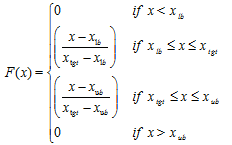
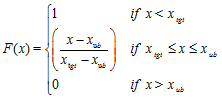
The only statistic available for the desirability option is the mean.